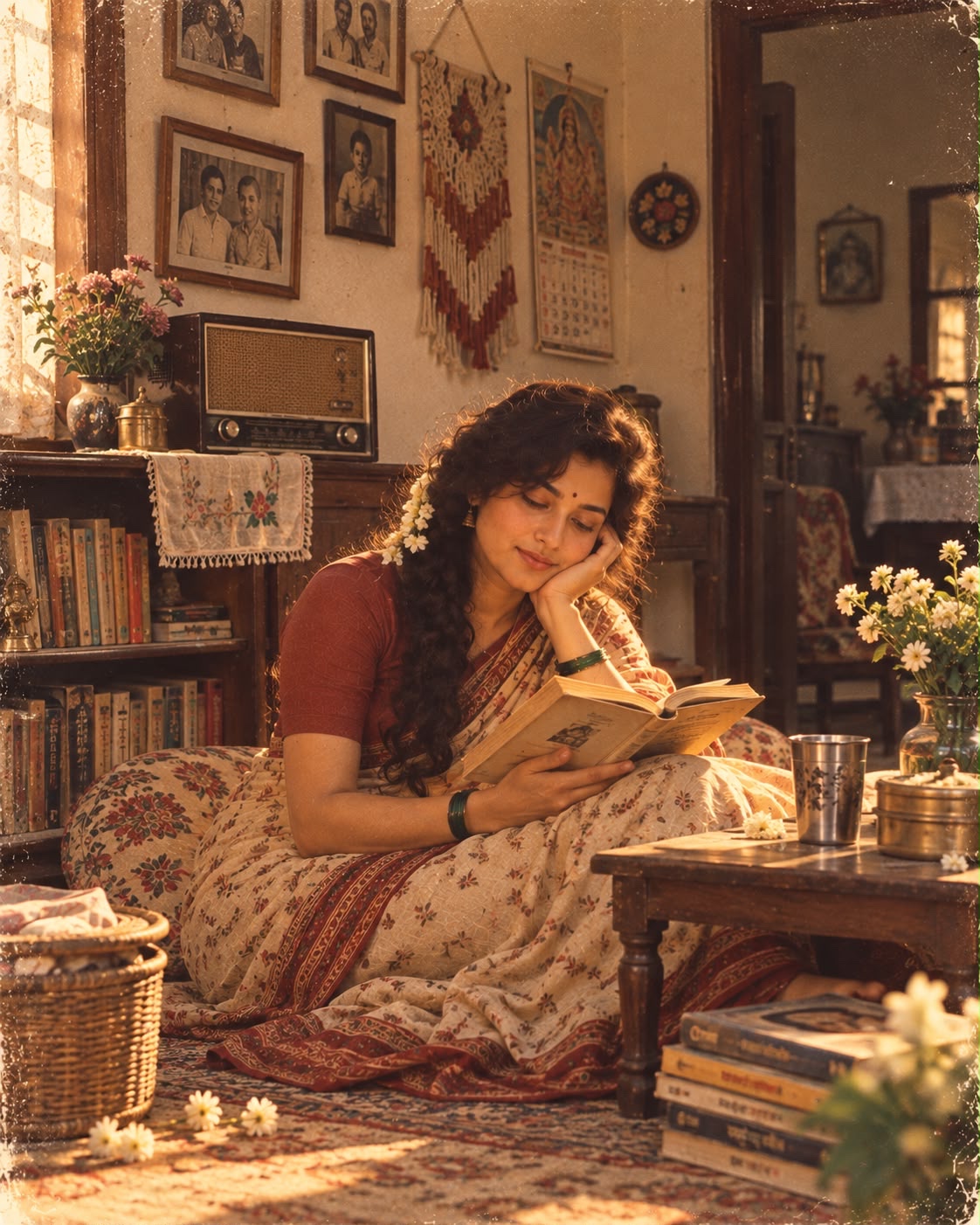
Ek khuli kitab, wooden bookshelf, purana radio aur window se aati soft roshni—iss portrait ki story quiet reading time hai. Glamorous pose se zyada believable home, comfortable body language aur natural face important hain.
Neeche complete 1970s Indian home reading AI photo prompt hai, saath mein hairstyle, props aur lighting ke practical fixes.

Example note: Yeh supplied AI-generated scene reference hai, asli 1970s ki archival photo nahi. Image aur prompt visually compare kiye gaye hain; in prompts se naya test output generate nahi kiya gaya. Original identity reference ke bina exact face match verify nahi hua. Period accuracy aur “Kodak” wording visual direction hain, historical proof ya exact film-stock simulation nahi.
Example aur prompt mein kya difference hai?
Floor-seated reading pose, cotton saree, jasmine, bookshelf, old-style radio aur wall photographs requested mood se broadly match karte hain. Lekin original prompt completely open wavy hair maangta hai; supplied example mein hair largely braid mein hai aur cheek ek hand par rest karti hai.
Visible radio ko image se exact transistor model ya date ke roop mein authenticate nahi kar sakte. Book, calendar aur wall photographs bhi historical evidence nahi hain. Example ka overall colour warm hai; softer neutral version chahiye toh warmth reduce karein.
Copy: 1970s home reading saree prompt
Chehra same rehne ki guarantee nahi hai. Result ko apni reference photo se compare karo aur zaroorat ho to correction do.
Open hair ya example wali braid?
Original open-hair version ke liye main prompt ki wording rakhein. Image-style braid chahiye toh open-hair sentence replace karein—dono contradictory instructions ek saath na chhodein.
Scene-matching replacement: “Her long softly wavy hair is loosely braided over one shoulder, with a small cluster of jasmine flowers tucked beside the braid. She supports her cheek gently with one hand while the other holds an open book supported securely on her lap. Her gaze rests on the pages, not on the camera.”
Yeh editorial replacement hai, supplied output ka verified generation history nahi. Open-hair styling bhi facial identity ki guarantee nahi deti; original reference se features compare karna zaroori hai.
Apni photo se kaise banayein?
- Apni ya permission wali clear, unfiltered identity photo upload karein. Face, hairline aur jaw visible hon. Medium/full-body composition ke liye body reference bhi dein; close selfie se height ya body proportions establish nahi hote.
- Image-editing tool mein original photo ko identity reference aur article image ko scene reference label karein. Example wale person ka face apne face ki jagah use na karne dein.
- Relevant prompt box copy karein. Ek hi scene version use karein; original aur alternate poses ko ek saath combine na karein.
- Copied text mein agar generic “keep my head at the same angle” ya “change ONLY clothing, background and lighting” line aaye, requested pose/hairstyle change ke liye usse replace karein: “Preserve my identity; allow only the pose, gaze and hair styling specified in this scene.” Agar pose change nahi chahiye, original constraint rakhein.
- Generate hone ke baad reference se face compare karein. Light direction, head-to-body scale, neck, shoulders aur finger contact check karein. Ek correction mein ek main issue address karein.
Book-reading pose ko believable rakhein
Book ka weight lap, cushion ya supporting hand carry kare. Agar ek hand cheek par hai toh remaining hand aur lap milkar book ko support karein. Fingers pages mein dissolve na hon; book spine, covers aur page thickness coherent rahein. Gaze pages ki taraf ho.
Pose correction: “Keep a comfortable floor-seated posture, with the book resting securely on the lap. Preserve natural neck and shoulder alignment. Keep hands distinct, page edges coherent and the eyes looking down at the book without changing facial identity.”
Home lived-in ho, prop showroom nahi
Original prompt mein detailed decor list hai, lekin har object prominently dikhana necessary nahi. Radio, bookshelf, low table aur kuch wall photos scene establish kar dete hain. Foreground mein limited steel/brass objects rakhein. Television optional hi rahe; radio scene ka main entertainment detail hai.
Simplify correction: “Reduce decorative clutter. Keep the old radio, a modest bookshelf, low wooden table, a few family photographs and simple household objects. Avoid a curated modern boho interior and leave natural breathing space around the woman.”
Face bada ya lighting alag lage toh
Full-body reference nahi ho toh model se exact height ka promise mat expect karein. Sirf face shrink karne se neck aur shoulders ka mismatch reh sakta hai. Tighter portrait crop bhi useful alternative hai.
Proportion correction: “Use the original identity and body references to correct head-to-body scale, neck length, shoulder width and torso proportions. Preserve internal facial features and natural body shape. Do not slim the face or create a pasted-on head. Keep continuous jaw-to-neck lighting.”
Lighting correction: “Use one coherent scene light on the face, neck, hands and clothing. Match shadow direction, colour temperature and exposure to the surroundings. Remove separate beauty fill, glowing skin and artificial rim light.”
Texture correction: “Reduce heavy grain, scratches, excessive orange tint and beauty smoothing. Keep natural skin texture and clear eyes, with subtle print fading and restrained film softness.”
Book text, calendar aur export
AI book covers ya calendar dates ko real historical information ke taur par use na karein. Readable text important ho toh appropriate verified material manually add karein; warna lettering indistinct rakhein.
“Keep book titles, calendar dates and background text indistinct and non-readable. Do not invent real historical quotations or dated claims.”
Supplied image approximately 4:5 hai. Final 1080 × 1350 export ke liye actual dimensions check karein; prompt mein size likhna alone enough nahi. Hair, book corners aur saree folds crop mein preserve karein.
Final check aur sharing
- Eyes, nose, lips aur face shape original identity reference se compare karein; exact match guaranteed nahi hai.
- Fingers, wrists aur props ke contact check karein. Background people subject ke duplicates na hon.
- Modern objects, invented readable dates aur fake historical text remove karein.
- Image ko stretch na karein. Aspect ratio ke liye crop ya recompose karein, aur final pixel size separately check karein.
Share karte waqt “AI-generated 1970s-inspired portrait” label karein. Is look ka appeal believable everyday moment hai—har surface par scratches ya cinematic glow add karna zaroori nahi.
Related scene: 1970s railway station portrait prompt aur proportion fixes.
More trends
View all → AI Photo Editing
1970s Rooftop Saree AI Photo Prompt: Natural Retro Portrait
 AI Photo Editing
1970s Indian Optical Shop AI Photo Prompt: Retro Hero Portrait
 AI Photo Editing
1970s Indian Neighbourhood AI Photo Prompts: Saree aur Hero Portrait
 AI Photo Editing
1970s Railway Station AI Photo Prompt: Retro Hero Portrait Banayein
 AI Photo Editing
Romantic Navratri AI Photo Prompt: Create a Bollywood-Style Garba Moment
 AI Photo Editing